
Continued demand for the American unit from importers and the greenback's persistent gains against other Asian currencies put pressure on the rupee

Avoid thinking of investment as some 'become millionaire in a week' scheme, says Nikhil Sethi, founder and MD, Zuvomo, a crowdfunding firm. Always think of long term gains and plan your trades accordingly.

India's current account slipped into a deficit of $9.6 billion or 1.3 per cent of GDP in the September quarter, the Reserve Bank said on Friday. The current account, which records the value of exports and imports of both goods and services along with international transfers of capital, was in a surplus mode both in the quarter-ago and year-ago periods. India's current account surplus had stood at $6.6 billion or 0.9 per cent of GDP in the April-June 2021 quarter, while in the year-ago period (Q2FY22), the surplus had stood at $15.3 billion or 2.4 per cent of the GDP, the data said.

Banks and exporters preferred to reduce their dollar position in view of its weakness.

It is undeniable that India's foreign exchange reserves have helped in limiting the impact of the financial crisis. If India had gone into the crisis with $100 or even $150 billion of reserves instead of $300 billion, the rupee would have declined more steeply, more quickly. China with its nearly $2 trillion of reserves suffered very little effect on the currency, says Arvind Subramanian.

The government has hiked gold import duty to 15 per cent from 10.75 per cent to check the current account deficit (CAD) and rising import of the yellow metal. The duty changes came into effect on June 30. Earlier, the basic customs duty on gold was 7.5 per cent, now it will be 12.5 per cent.

UltraTech Cement was the top gainer in the Sensex pack, rising over 3 per cent, followed by Kotak Bank, ICICI Bank, Asian Paints and Tata Steel.

The Reserve Bank's rate-setting panel will start its 3-day deliberations on Wednesday amid expectations of yet another rate hike of 50 basis points to check high inflation, in line with similar actions taken by other major central banks, including the US Fed. Based on the recommendations of the Monetary Policy Committee (MPC), the RBI had effected 50 basis points increase in repo rate each in June and August after raising the short-term lending rate by 40 basis points in an off-cycle decision in May. The MPC, headed by RBI Governor Shaktikanta Das, is scheduled to meet during September 28-30.

India's projected economic growth for 2022 has been downgraded by over two per cent to 4.6% by the United Nations, a decrease attributed to the ongoing war in Ukraine, with New Delhi expected to face restraints on energy access and prices, reflexes from trade sanctions, food inflation, tightening policies and financial instability, according to a UN report released on Thursday. The UN Conference on Trade and Development (UNCTAD) report downgraded its global economic growth projection for 2022 to 2.6 per cent from 3.6 per cent due to shocks from the Ukraine war and changes in macroeconomic policies that put developing countries particularly at risk. The report said while Russia will experience a deep recession this year, significant slowdowns in growth are expected in parts of Western Europe and Central, South and South-East Asia.
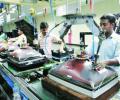
'The government expects demand for electronic products to reach $400 billion by 2023-24. This would be a huge foreign exchange outflow, which may further widen our trade deficit with other nations. Hence, the government plans to push local electronics manufacturing to cut down on their import bill.'

Titan was the top gainer in the Sensex pack, climbing over 4 per cent, followed by Bajaj Auto, Maruti, Reliance Industries, ONGC and UltraTech Cement.

The employment situation remains dire. Whatever can be done to promote greater low-skill employment should be pursued aggressively, advises former chief economic adviser Shankar Acharya.
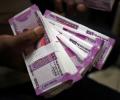
Ongoing trade-war rhetoric between the US and China added some nervousness on the trading front coupled with extremely bullish dollar sentiment overseas.

IndusInd Bank was the top laggard in the Sensex pack, falling over 5 per cent, followed by HDFC, Axis Bank, PowerGrid, SBI, Bajaj Finserv and Bharti Airtel.

Tata Steel was the top loser in the Sensex pack, shedding over 4 per cent, followed by Bharti Airtel, Axis Bank, ONGC, SBI and Sun Pharma.

The US dollar surged to fresh one-year high after the Fed chief's testimony to the US Senate on Wednesday bolstered the expectations of interest rate hikes, though gradually.

Not only is gold a hedge against currency depreciation, rising crude prices and uncertainty, it is up 7 per cent (in dollar terms) in the past 12 months, says Devangshu Datta.

For the banking system a new cycle starts in FY2024. It's fraught with fresh challenges on asset quality and profitability, warns Tamal Bandyopadhyay.
The rupee has been under immense pressure due to a host of reasons including soaring crude oil prices, sustained foreign fund outflows and widening current account deficit.

On the Sensex chart, Bajaj Auto, HDFC, Infosys, Tech Mahindra and ICICI bank emerged as the prominent gainers. NSE Nifty ended with a gain of 106.95 points at 14,724.80.
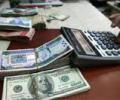
Royal Bank of Scotland and JP Morgan were also fined over attempts to rig currency benchmarks in a year-long probe that has put the largely unregulated $5 trillion-a-day market on a tighter leash, with dozens of dealers suspended or fired.
Robust trade and overseas investment inflows along with revaluation of currencies propelled India's foreign exchange reserves to rise further by $1.56 billion to cross $125 billion mark during the week ended November 19.
Emerging countries should not accumulate too much foreign exchange reserves as such a buildup has its own limitations and at a particular point complicates monetary policy, IMF managing director Rodrigo de Rato said.
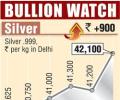
Silver also saw a hefty rise of Rs 900 to Rs 42,100 per kg on increased offtake by industrial units and coin makers.
In the global market, dollar fell against most of its rivals on Monday.
India's foreign exchange reserves rose further by $1.31 billion to cross $123 billion during the week ended November 12 due to huge overseas investment in stock market and trade inflows.

Rupee ends flat against dollar ahead of Fed policy outcome.
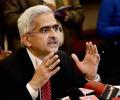
Reserve Bank Governor Shaktikanta Das on Monday said despite the latest headwinds arising from the Jackson Hole summit leading to extreme volatility, our banking system and financial markets are strong enough to withstand such pressures. Taking the markets by surprise, US Fed chair Jerome Powell had told the annual Jackson Hole summit of central bankers and economists last week that he would have to keep raising federal fund rates to tame inflation, which remains the biggest challenge to the world's largest economy. He also warned of the pains that such monetary policy actions would create on growth and jobs.
These measures, under preliminary discussion with the central bank, come soon after Hexaware Technologies, an IT services company, recently said it was providing Rs 80-100 crore due to losses allegedly on account of foreign exchange transactions fradulently entered into by one of its officials with banks.

ONGC was the top gainer in the Sensex pack, rallying 5.52 per cent, followed by Titan, Reliance Industries, HDFC Bank and Bajaj Finance. NSE Nifty surged 161.75 points to close at 10,901.70.

IndusInd Bank was the top gainer in the Sensex pack, rallying over 4 per cent, followed by Bharti Airtel, Axis Bank, ICICI Bank, Bajaj Finance, Sun Pharma, HDFC and Kotak Bank. On the other hand, Titan, Maruti, ITC, Asian Paints, HCL Tech and Bajaj Auto were among the laggards.

SBI was the top loser in the Sensex pack, shedding over 4 per cent, followed by Bajaj Finserv, Axis Bank, ONGC, ITC, ICICI Bank, Bajaj Finance, Kotak Bank and HDFC Bank.

The dollar index was down by 0.02 per cent against a basket of six major currencies.

In worldwide trade, the US dollar continued its highly bullish trend against all major emerging market currencies

Other gainers included Nestle India, Asian Paints, Bajaj Finance, NTPC, L&T, Axis Bank and Bajaj Auto. On the other hand, TCS, ONGC, Infosys, HDFC and SBI were among the laggards. NSE Nifty surged 121.65 points or 1.03 per cent to 11,889.40.

While the tax treatment does legitimise past crypto transactions, there is a possibility that any, or all, private cryptocurrencies will be banned in future.
Traders said the rupee was also supported by speculation that May wholesale inflation due this week may show continued easing.

HCL was followed by Tech Mahindra, Asian Paints, Bharti Airtel, HDFC Bank, L&T, TCS, M&M, Nestle India and Infosys. NSE Nifty rose 23.75 points or 0.20 per cent to 11,896.80.

The rupee had ended 79 paise higher to close at 55.15 against the US currency in the previous session on Friday.

The rupee gained 31 paise to close at 66.42 in Thursday's trade.
